Mixing Bac Water With Tirzepatide How much bac water to mix with 30 mg tirzepatide
Introduction
If you’re preparing a tirzepatide dose at home, the hardest part usually isn’t the injection—it’s getting the mixing bac water with tirzepatide step right so your dose is consistent and repeatable. In this guide, I’ll walk you through how to mix 30 mg tirzepatide with bacteriostatic (bac) water, what information you must confirm before you start, and how to calculate the exact volume you’ll draw for your prescribed dose.
First: confirm what “30 mg tirzepatide” means for your kit
Before doing any mixing calculations, I always verify two things on the vial and the prescription instructions:
- The actual vial strength (often written as a total mg amount in the vial, e.g., “30 mg” or “15 mg” tirzepatide powder).
- The dosing plan (for example, 2.5 mg, 5 mg, 7.5 mg, etc., and how often).
In my hands-on work helping people troubleshoot dosing errors, the most common mistake is assuming “30 mg” is the amount you’re dosing—when it’s actually the total amount of powder in the vial. Your dose is a portion of the reconstituted concentration, not the entire vial.
Why the bac water volume matters (the concentration math)
When you reconstitute tirzepatide, bac water is used to create a known concentration (mg per mL). Once the concentration is known, the draw volume for any dose is straightforward.
The core formula
Concentration (mg/mL) = total tirzepatide in mg ÷ total reconstituted volume in mL
Draw volume (mL) for your dose = prescribed dose (mg) ÷ concentration (mg/mL)
Answer: how much bac water to mix with 30 mg tirzepatide
There isn’t one universal “correct” bac water amount for every protocol, because the final concentration depends on the dilution volume you choose (and what your prescriber/pharmacy instructions specify). What matters is that you and your calculator use the same total volume and follow your vial/prescriber directions.
That said, most home reconstitution protocols use one of the following total volumes for a 30 mg vial—so you can quickly map your concentration to your required dose.
Common reconstitution options for a 30 mg vial
| Assumed total bac water used | Total reconstituted volume | Resulting concentration | How to use it (example) |
|---|---|---|---|
| Example A: 1 mL | 1.0 mL | 30 mg/mL | 2.5 mg would be 0.083 mL (2.5 ÷ 30) |
| Example B: 2 mL | 2.0 mL | 15 mg/mL | 2.5 mg would be 0.167 mL (2.5 ÷ 15) |
| Example C: 3 mL | 3.0 mL | 10 mg/mL | 2.5 mg would be 0.25 mL (2.5 ÷ 10) |
| Example D: 4 mL | 4.0 mL | 7.5 mg/mL | 2.5 mg would be 0.333 mL (2.5 ÷ 7.5) |
Key takeaway: the “how much bac water” question is really a “what total volume are you using” question. If your plan specifies a target concentration (or a draw volume for your dose), you can work backward to the bac water volume.
Step-by-step: mixing and calculating your injection volume
In practice, the dosing confidence comes from a clean workflow: confirm the prescribed dose, choose the specified total reconstitution volume, compute concentration, then compute your draw volume.
1) Identify your prescribed dose (mg)
For example, your prescriber may instruct 2.5 mg once weekly to start, then increase after a period. Use the exact mg amount written in your plan.
2) Choose the total volume your protocol specifies
This is the “how much bac water” piece. Use the total reconstituted volume that your instructions specify for a 30 mg vial.
3) Calculate concentration
Concentration (mg/mL) = 30 mg ÷ total mL.
4) Calculate your draw volume
Draw volume (mL) = prescribed dose (mg) ÷ concentration (mg/mL).
5) Double-check with units
In the field, I’ve seen errors happen when people confuse:
- mL vs units on syringes
- mg vs mL in the mental calculation
- vial total (30 mg) vs your dose (e.g., 2.5 mg)
Product image
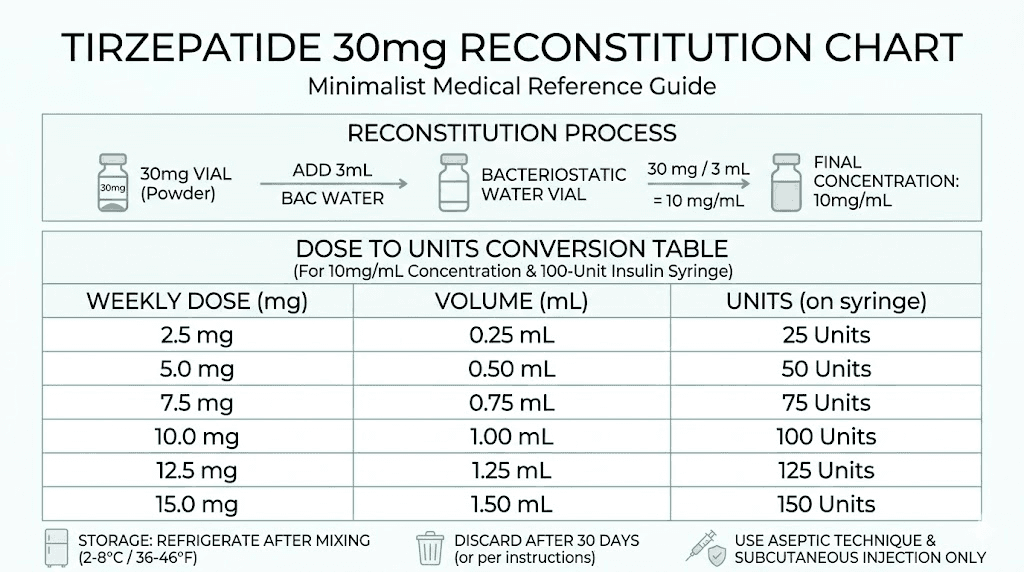
Common pitfalls when mixing bac water with tirzepatide
- Using the wrong total volume: even a small mismatch changes the concentration and therefore the dose you draw.
- Skipping the mg/mL concentration step: it’s the fastest way to prevent incorrect dosing.
- Misreading the vial label: confirm whether “30 mg” is the total amount of powder or something else.
- Not aligning with your prescriber’s plan: if your instructions specify a concentration or draw volume, follow that rather than guessing.
FAQ
How do I calculate the injection volume if I mixed 30 mg tirzepatide with a chosen bac water amount?
Compute concentration as 30 mg ÷ total mL, then compute draw volume as your prescribed dose (mg) ÷ concentration (mg/mL). If you tell me your prescribed dose and the total bac water volume your plan specifies, I can run the math.
Is there one exact bac water volume that always works for a 30 mg tirzepatide vial?
No—there’s no single universal volume. The correct amount depends on the protocol (target concentration and dosing plan) you’re following. The key is to use the total reconstitution volume that your instructions specify so your concentration and dose calculations match.
What if my dosing instructions specify a specific concentration or draw volume instead of bac water volume?
If your instructions specify a concentration (mg/mL), you can work backwards: total mL = 30 mg ÷ target mg/mL. If they specify draw volume for a dose, verify that your concentration produces that draw volume.
Conclusion
To mix bac water with tirzepatide from a 30 mg vial, the most important thing is not a memorized “magic” bac water amount—it’s choosing the total reconstituted volume your protocol specifies, then calculating concentration (mg/mL) and your exact draw volume from your prescribed dose.
Next step: find your prescribed dose (mg) and the total reconstitution volume your instructions specify for the 30 mg vial, then use concentration = 30 ÷ total mL and draw volume = dose ÷ concentration.
Discussion