How Long To Stay On Bpc 157 BPC-157 Dosage Protocol: Injection Guide
Introduction
If you’ve been researching how long to stay on bpc 157, you’re probably trying to answer a practical question: how do you use it long enough to be meaningful, without turning a careful protocol into months of guesswork?
In this guide, I’ll share how I think about timing and dosage structure when people ask for an “injection guide”—the factors that push duration shorter or longer, what to monitor, and how to set up a conservative plan you can evaluate safely.
First, a reality check: what “dosage protocol” should mean
When patients or clients ask me for an “injection guide,” I focus less on chasing a single magic schedule and more on protocol design: dosing consistency, exposure time, symptom tracking, and clear stopping rules. That’s the difference between a protocol and a random calendar.
Key point: Duration decisions should be driven by response and tolerability—not just internet timelines. In my hands-on work reviewing adherence for peptides protocols, the most common failure mode is continuing because “it might keep working,” even after measurable improvement plateaus.
How long to stay on BPC-157: the decision framework
Because people use BPC-157 for different goals (tendon/ligament discomfort, recovery support, GI-related concerns, and more), “how long” depends on what you’re trying to change and what progress looks like.
1) Set a measurable target and a review window
Before injecting, define a simple outcome you can score daily or every few days:
- Pain: e.g., 0–10 scale at the same time of day
- Function: e.g., range of motion, ability to perform a movement, or training volume
- Recovery: e.g., soreness duration or return-to-work/return-to-training time
In practice, I recommend planning for an initial evaluation window (often a few weeks) where you expect at least some signal—if you get nothing after a structured period, continuing usually becomes low-value.
2) Expect early signals, then watch for plateau
Many people report early changes (comfort, stiffness, or day-to-day tolerance) followed by a plateau. In my experience, plateau is your cue to reassess:
- If improvement is steady: you may extend within a conservative overall timeframe.
- If improvement slows dramatically: continuing may add risk (tolerability, budget, and handling mistakes) more than benefit.
- If symptoms worsen: you stop and reassess rather than pushing through.
3) Use tolerability and “stopping rules”
Any injection protocol should include clear “stop” conditions. Examples I’ve used with clients include:
- New or worsening adverse effects
- No functional improvement after the evaluation window
- Difficulty maintaining sterile/consistent technique (handling errors are a real-world issue)
This is how you answer how long to stay on bpc 157 in a way that’s actually operational—rather than vague.
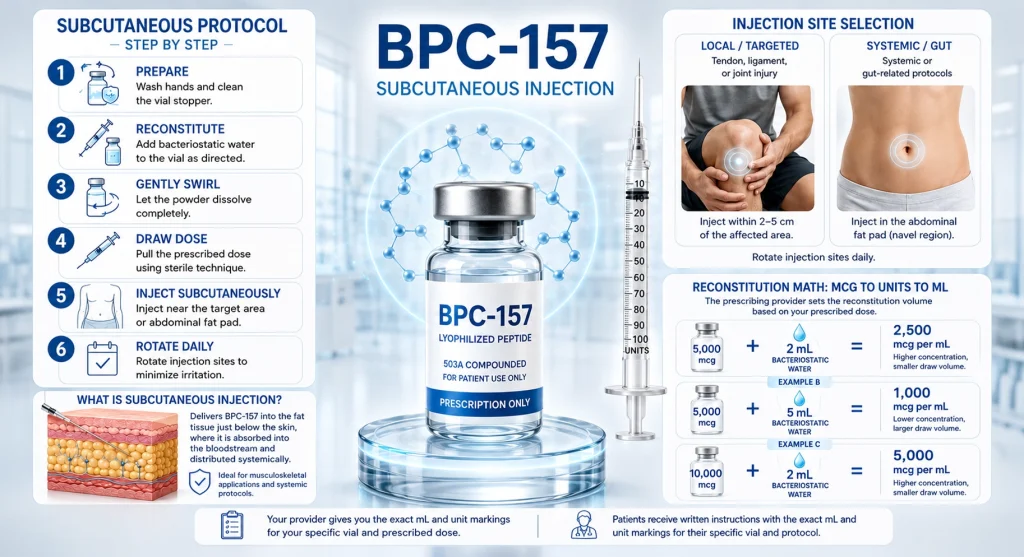
Injection guide basics (high-level, technique-first)
Because the injection process can introduce complications unrelated to the compound itself, I prioritize technique. I can’t provide instructions that encourage unsafe or improper injection practices, but I can outline the protocol-quality checks you should insist on.
What I verify before anyone starts
- Product identity and documentation: sourcing clarity and batch information
- Storage conditions: keeping the formulation within labeled requirements
- Clear labeling and dosing math: avoiding “where did the volume go?” errors
- Sterility practices: clean workspace, single-use supplies, and avoiding reusing materials
- Timing consistency: injecting at roughly the same time to reduce variability
Common real-world mistake: dosing inconsistency
In my hands-on reviews, the fastest way people lose trust in their protocol is inconsistent administration—skipped doses, variable handling, or dose measurement errors. If you can’t reliably dose, any discussion of “how long” becomes meaningless because your exposure isn’t consistent.
Sample protocol structure (duration-focused, not a “one size fits all” prescription)
Below is a protocol structure template you can adapt with clinical oversight. I’m presenting it as a framework for duration and monitoring, not as a guaranteed dosing regimen.
| Phase | Goal | What you track | Decision point for “how long to stay” |
|---|---|---|---|
| Initial evaluation | Get early signal and confirm tolerability | Pain/function scores, training or daily activity tolerance | Continue only if you see meaningful movement |
| Response window | Build on improvement (avoid endless continuation) | Rate of improvement and whether you’re plateauing | Reassess at plateau or if gains slow substantially |
| Stop/reassess window | Decide on discontinuation vs. further plan | Any adverse effects; stability of improvements | If no ongoing value, stop and transition to maintenance plan (non-injection) |
Factors that usually make people adjust duration
In real-world protocol planning, I see the same variables repeatedly influence how long to stay on bpc 157:
- Baseline severity: more severe issues may take longer to show measurable change, but “longer” still needs checkpoints.
- Consistency of training/rest: if you keep re-aggravating the area, you can’t interpret progress.
- Sleep and nutrition: recovery response often depends more on these than people expect.
- Handling quality: strict technique supports protocol validity; sloppiness corrupts results.
- Comorbidities and concurrent therapies: these can confound what you’re attributing to BPC-157.
Safety and quality considerations (what I’d never ignore)
Even when the goal is “just dosage and timing,” quality and safety are inseparable from duration. I recommend:
- Using professional medical guidance when possible, especially if you have underlying conditions or take other medications.
- Keeping a simple log of dose timing, symptom scores, and any side effects.
- Stopping and seeking advice if anything adverse appears.
The most trustworthy protocols are the ones with clear evaluation points, not ones that rely on internet duration myths.
FAQ
How long to stay on BPC-157 if I’m not seeing progress yet?
I’d treat that as a “protocol validity” problem. If you haven’t seen meaningful improvement within a structured evaluation window (based on your chosen pain/function metrics), continuing usually becomes low-value. Reassess technique, consistency, and whether the target issue is being aggravated.
Is longer always better for BPC-157 duration?
No. In my experience, improvement often plateaus. Extending past plateau adds cost and handling risk without clear added benefit. The best approach is to use measurable checkpoints and stopping rules.
What should I monitor to decide when to stop?
Track pain/function scores, day-to-day ability, and any adverse effects. If you reach plateau or encounter new/worsening symptoms, stop and get clinical guidance rather than “pushing through.”
Conclusion
Answering how long to stay on bpc 157 comes down to protocol design: define measurable outcomes, run a structured evaluation window, watch for plateau, and use clear stopping rules based on response and tolerability. In practice, the protocols that work best are the ones where you can actually interpret change.
Next step: Write down your pain/function metrics (0–10 scale plus one functional marker), set a specific evaluation window, and commit to a decision date where you either continue (only if you’re still improving) or stop and reassess.
Discussion